 WhatsApp
Office interiors · Delhi
Office Interior Design and Build
in Delhi
IBS designs and builds office interiors in Delhi, where its local teams deliver the work. The in-house design team designs the interior and its services. IBS’s own engineers and workmen build the floor: civil work, MEP (mechanical, electrical and plumbing), HVAC (heating, ventilation and air conditioning), fire fighting, painting and furniture. Where an architect leads, IBS builds the architect’s design. A Delhi programme also has to fit air-quality curbs, goods-vehicle entry rules and the monsoon.
Request a site survey →
Who designs and builds office interiors in Delhi, and what does the city change?
One firm can design and build a Delhi office under a single contract, or your architect designs it and a contractor builds it. IBS does both, and its local teams in Delhi deliver the work. The city adds a calendar. At Stage III of GRAP, the region’s air-quality action plan, tile cutting, plaster, masonry and painting are restricted. Goods vehicles face entry rules all year.
What is GRAP?
GRAP is the Graded Response Action Plan, the schedule of air-quality curbs that the Commission for Air Quality Management (CAQM) issues for Delhi and the National Capital Region (NCR). Each stage is tied to the air quality index (AQI): Stage III to 401 to 450, Stage IV to above 450. CAQM revised it on 29 September 2026, with immediate effect.
What is a fire safety certificate?
A fire safety certificate is the document Delhi’s fire service rules provide for buildings in the classes they list, business buildings over 15 metres or of five or more storeys among them. A buyer may know it as a fire NOC (no objection certificate). Under rules amended in 2026, an empanelled fire safety auditor (one on an official panel) issues it.
What is a BOQ?
A BOQ is the bill of quantities: every item in the fit-out with a quantity and a rate, from the gypsum false ceiling and floor screed to HVAC ducting, conduit, DB panels (distribution boards), earthing and sprinkler heads. IBS prices a line-item BOQ against the drawings and gives no rate per square foot.
Air quality
Which office fit-out work is restricted under Delhi’s air-quality curbs?
GRAP Stage III is set at an AQI of 401 to 450. Its schedule restricts some construction and demolition activities by name and lets less dusty work go on. This page does not say which stage is in force today; check CAQM’s orders.
Restricted by name at Stage III
- Painting, polishing and varnishing works
- Cutting, grinding and fixing of tiles, stones and other flooring materials, except for minor indoor repairs and maintenance
- Plaster, masonry and demolition
- On an office floor that takes in wall paint, polish on veneer, vitrified tile and stone flooring, blockwork and the strip-out of an old interior
Permitted to continue
- Construction activities that are not on the restricted list and are “relatively less polluting / less dust generating”
- Minor welding for MEP works, permitted by name
- Minor indoor repairs and maintenance to plaster, tile, stone and other flooring
What the schedule does not say
- The words carpentry, interior and furnishing appear nowhere in its 17 pages
- Joinery fixing and furniture installation therefore continue by inference, under the clause for less dusty work. No exemption names them
- Ask your landlord how the building applies Stage III to interior trades, and keep the reply in writing
- The restricted list is longer than the lines quoted here. Read it in full before a programme is fixed
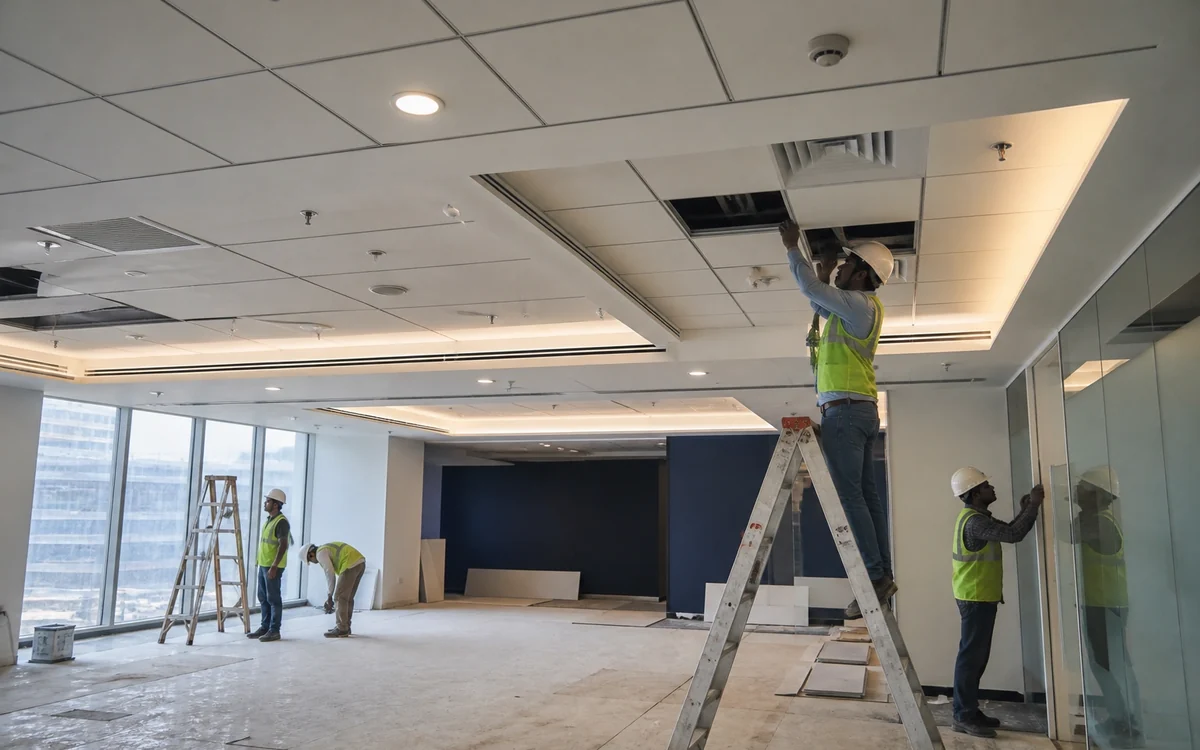
Programme
How do you sequence a Delhi fit-out around the winter curbs and the monsoon?
A GRAP stage follows the AQI reading, so no programme can date a stoppage in advance. It can show where each named trade sits. The monsoon can be dated, from the normal dates of the India Meteorological Department (IMD).
Early in the job
- Demolition, masonry and plaster are named at Stage III, and they open most fit-outs
- A stop here delays every trade behind it, so finish these first where your lease allows
- A floor with an old interior to strip out carries more of this work. Check how much at the site survey
In the middle
- MEP first fix fills the middle of the job: conduit and cable trays, HVAC ducting, sprinkler pipework
- Second fix follows: DB panels, earthing, diffusers, smoke detectors and light fittings
- Minor welding for MEP works stays permitted at Stage III. Other MEP tasks may continue where they are off the restricted list and relatively less dust generating
At the end
- Tile and stone fixing, painting, polishing and varnishing are finishing trades, and all are named
- A Stage III stop in the last weeks can hold a handover even with the gypsum ceiling closed and the HVAC running
- Where the move-in date falls in winter, put float (spare days) against the finishing trades
In the monsoon
- IMD’s normal onset over Delhi is 27 June and its normal withdrawal 25 September, about thirteen weeks apart
- Work inside a closed floor carries on through the rain
- Terrace HVAC units, roof penetrations and external pipework are the weather-exposed items. Ask where they fall against those dates

Deliveries
How does fit-out material get into Delhi?
Gypsum board, glass, vitrified tile, HVAC equipment and furniture arrive on goods vehicles. Three sets of rules decide which vehicle may enter, and when.
All year: which vehicle may enter
- Since 1 November 2025 a commercial goods vehicle may enter Delhi only if it is BS-VI (Bharat Stage VI, an emission class), CNG, LNG or electric
- Every size of goods vehicle is covered. Those registered in Delhi are excepted
- BS-IV vehicles may enter up to 31 October 2026. CAQM’s website listed no extension when we checked on 9 October 2026
By the clock: restricted hours
- A June 2024 notification from Delhi Traffic Police applies the same restricted hours to heavy, medium and light goods vehicles: 7 am to 11 pm
- Peak hours within them are 7 am to 11 am and 5 pm to 11 pm
- A No Entry Permission from the traffic police covers a vehicle plying during restricted hours
- It names no roads, and we could not check for later changes. Confirm your route and hours with the transporter
When a GRAP stage is invoked
- Stage III bars BS-IV and older diesel medium and light goods vehicles registered outside Delhi
- Stage IV, above an AQI of 450, stops the entry of trucks (heavy goods vehicles) into Delhi
- LNG, CNG, electric and BS-VI diesel trucks stay permitted at Stage IV
What to settle before ordering
- Which class of vehicle carries each consignment, starting with items on a long lead time: VRF (variable refrigerant flow) outdoor units, AHUs (air handling units), DB panels and glass
- Whether your building takes deliveries at night, outside the restricted hours
- Where each delivery sits against the lead time IBS shows in its quotation
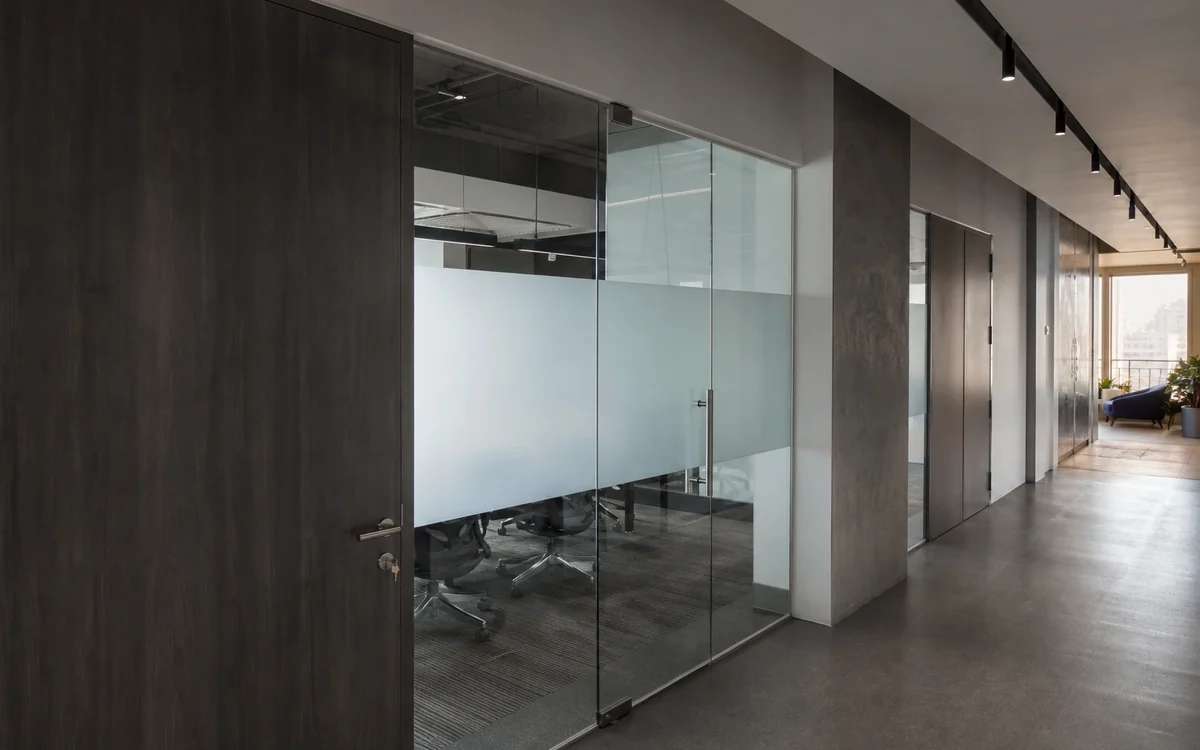
Who builds it
Who delivers an IBS office project in Delhi?
IBS’s local teams do. IBS is a national contractor with a local presence in Delhi, and it has local teams in India’s major cities, Tier 2 and Tier 3 cities included.
In Delhi
- IBS has a local presence in Delhi, and its projects in the city are delivered by its local teams
- The trades are IBS’s own engineers and workmen: civil, MEP, fire fighting, HVAC, interiors, painting and furniture
- A site survey of your floor comes before the quotation
- Progress goes to the PMC (project management consultant) against the programme, with HSE (health, safety and environment) and quality plans
Across the company
- An in-house design team for every discipline: interiors, electrical, HVAC, plumbing and fire fighting
- IBS’s own furniture and joinery factory, near Vasai East
- A print branding line that makes reception logo walls, glass film, wall graphics, wayfinding and cabin name plates in the same programme
- Head office in Goregaon West, Mumbai, and projects executed across India
Clients and credentials
- National enterprise clients include Adani Airports, Reliance Retail, Tata CLiQ, Aditya Birla Fashion and Retail, GroupM, Belgian Waffle, EPSON, Canon, Planet Retail, Society Tea and Duravit
- Approved vendor at Adani Airports, HDFC ERGO, Reliance Retail, Godrej Finance, EPSON, Duravit, HSBC, Tata CLiQ, Canon, Aditya Birla Fashion and Retail and HDFC Life
- Office interior work delivered for GroupM in Mumbai
- Largest single order executed to date: ₹25 Crore
- BCAS-cleared (Bureau of Civil Aviation Security) to work across the entire airport premises, including airside, with all registrations required under Indian law
At handover
- Test certificates and as-built drawings
- A closed snag list (the defects put right before you accept the floor)
- Twelve months’ cover on installation, with each manufacturer’s warranty passed through
- The defect liability period, the time after handover for putting defects right, is the one your contract sets
Fire
Who is responsible for the fire safety certificate of a Delhi office?
Delhi’s fire law is the Delhi Fire Service Act, 2007, with the Delhi Fire Service Rules, 2010 and an amendment gazetted on 26 May 2026.
Who the duty falls on
- The Act lets the Government require the owner, the occupiers or both to take the prescribed fire prevention and fire safety measures
- The Rules put upkeep on the occupier, who maintains those measures
- Your lease should say how the duty is divided between you and the building’s owner
Which office buildings are covered
- Business buildings more than 15 metres high
- Business buildings of five or more storeys, counting a mezzanine or stilt floor above ground level
- Ask the landlord for a copy of the building’s certificate, which you may hear called its fire NOC
What changed in 2026
- Under the amended rules an empanelled fire safety auditor, engaged by the owner or occupier, issues the certificate, deemed issued under the Director’s delegated authority
- Before the amendment the Director of the Delhi Fire Service issued it, for three years on a non-residential building
- The amended certificate has no fixed term: it stays valid subject to a form submitted every year, unless suspended or cancelled
- The change was written to take effect 90 days after the gazette. We could not confirm whether that was deferred
What it means for your fit-out
- Show the landlord any layout that moves sprinkler heads, smoke detectors or fire-rated partitions before the GFC drawings (good for construction, the set a site builds from) are issued
- Every licence, permit and NOC is yours to obtain. IBS can prepare the application drawings and handle the liaison, as a separately charged service
- Whether a one-floor tenant needs an audit of its own is a point we could not settle from the rules. Ask the landlord and the auditor
Power
Which electricity company supplies a Delhi office, and how do you get more load?
Delhi has three distribution licensees (companies licensed to supply electricity), each with its own districts. The lists are from the licences of 11 March 2004. Names may have changed, so confirm the licensee on your electricity bill.
BSES Rajdhani Power Limited
- Its licence lists 11 districts
- Nehru Place, Alaknanda, Nizamuddin and R.K. Puram
- Mehrauli, Janak Puri, Vikas Puri and Palam
- Punjabi Bagh, Najafgarh and Nangloi
BSES Yamuna Power Limited
- Its licence lists 10 districts
- Chandni Chowk, Darya Ganj, Pahar Ganj and Shanker Road
- Krishna Nagar, Laxmi Nagar and Mayur Vihar
- Jhilmil, Yamuna Vihar and Nand Nagri
Tata Power Delhi Distribution Limited
- Its licence, printed in the name North Delhi Power Limited, lists 10 districts
- Keshav Puram, Pitampura, Moti Nagar and Civil Lines
- Shakti Nagar, Rohini and Mangol Puri
- Shalimar Bagh, Narela and Bawana
Deemed licensees, and more load
- DERC (the Delhi Electricity Regulatory Commission) also lists the New Delhi Municipal Council and the Military Engineering Services as deemed licensees (bodies the law treats as licence holders). This page does not map their areas
- VRF air conditioning, a server room or a pantry can take a floor past its sanctioned load, the load the licensee has agreed to supply
- More load is applied for as load enhancement under the DERC supply code, in the format the Commission notifies, following the procedure for a new connection
- Ask for the connected load (the total wired to it) of every DB panel on the electrical drawings, and find out whose name the connection is in
Routes
Will IBS design our Delhi office, or build our architect’s design?
Both routes are open. Choose before you ask for a price, because the route settles who draws, who approves and what gets priced.
With no architect
- IBS’s in-house design team designs the interior and the MEP services: electrical, HVAC, plumbing and fire fighting
- Design and build sit under one contract
- Design appears in the quotation as a line of its own
- Materials are your choice, from options priced against your budget
With an architect in the lead
- IBS builds the architect’s design, issued as GFC drawings, and does not compete for it
- Site queries reach the architect in writing and are tracked until each has an answer
- A saving is put forward only as a priced alternate
- Shop drawings (the maker’s detailed drawings) come before fabrication, and a mock-up is built where the contract asks for one
How the price is built
- Before the site survey, ask the landlord what the floor is handed over with: HVAC, sprinklers, smoke detectors and the DB panel
- The quotation is a line-item BOQ against the drawings, with no rate per square foot
- It states the programme and shows the lead time of long-lead equipment against it. Ask for the Stage III trades to be marked as well
- Who carries the cost of a GRAP stoppage is a contract term. Agree it in writing before the order
Market data
How much office space is leased in Delhi NCR, and what does a fit-out cost?
Two published figures, each from a named firm. Neither is an IBS price, and IBS gives no rate per square foot.
Leasing in 2025 (JLL)
- Delhi NCR recorded 17.4 million sq ft of gross office leasing in 2025
- The 2024 figure was 17.7 million sq ft, and JLL prints the change as -1.6%
- The 2025 figure is 20.9% of an India total of 83.3 million sq ft
- JLL’s label is Delhi NCR, a wider area than the city of Delhi
Fit-out cost in 2026 (Cushman & Wakefield)
- About ₹6,207 per sq ft for a collaborative hybrid office fit-out, under the city label Delhi
- Second of the eight cities in the guide
- The guide’s web page does not say whether Delhi means the city or the wider region
- For scale, 10,000 sq ft at that market figure works out to about ₹6.21 Crore
Why your price will differ
- The floor as handed over: an empty one needs a gypsum false ceiling, floor screed and HVAC distribution that a fitted one may already have
- The MEP scope, such as a server room or added cooling
- The finishes you choose, for example laminate against veneer on joinery, or carpet against vitrified tile
- In Delhi, the programme: ask how the quotation treats a GRAP stop and night deliveries
Fitting out an office in Delhi?
Send the address, the carpet area, your headcount and your move-in date, and say whether the work will cross winter or the monsoon. IBS carries out a site survey, then prices a line-item BOQ with the programme and each long lead time stated.
Request a site surveyWhat limits a Delhi office fit-out, and who sets each limit?
Seven limits from the sections above. Use the table as a checklist with your landlord and your contractor.
| Set by | What it limits | What to check | |
|---|---|---|---|
| GRAP Stage III (AQI 401 to 450) | CAQM | Painting, polishing and varnishing; tile and stone cutting and fixing; plaster, masonry and demolition. Minor welding for MEP works is permitted | How your building applies it to interior trades |
| GRAP Stage IV (AQI above 450) | CAQM | Entry of trucks, except LNG, CNG, electric and BS-VI diesel trucks | The vehicle class for items on a long lead time, such as VRF units |
| Goods vehicle entry, all year | CAQM | Vehicles that are not BS-VI, CNG, LNG or electric, unless registered in Delhi | Whether BS-IV entry, allowed up to 31 October 2026, was extended |
| Restricted hours | Delhi Traffic Police, June 2024 notification | Goods vehicles from 7 am to 11 pm | A No Entry Permission, or night delivery at your building |
| Fire safety certificate | Delhi’s fire service rules | Business buildings over 15 metres or of five or more storeys | The building’s certificate, and any sprinkler or smoke detector your layout moves |
| Electrical load | DERC’s supply code | Load beyond the sanctioned figure | The licensee on your bill, and the connected load on each DB panel |
| Monsoon | IMD’s normal dates | 27 June to 25 September: terrace HVAC units and external pipework | Where outdoor work falls in the programme |
Market Context
What the published data says
- Stage III (AQI 401 to 450) restricts “Painting, polishing and varnishing works”, tile and stone cutting, grinding and fixing “except for minor indoor repairs/maintenance”, plaster, masonry and demolition. Less dusty construction continues, with minor welding for MEP works permitted. Stage III also bars BS-IV and older diesel medium and light goods vehicles from outside Delhi. Stage IV (AQI above 450) stops truck entry, except LNG, CNG, electric and BS-VI diesel. CAQM, GRAP schedule for NCR, revised 29 September 2026, Stage III items 1(i) and 1(ii)
- The revised schedule was issued “with immediate effect”. CAQM, Direction No. 104, 29 September 2026
- Since 1 November 2025 only BS-VI, CNG, LNG and electric commercial goods vehicles may enter Delhi. Delhi-registered vehicles are excepted, and BS-IV may enter up to 31 October 2026. CAQM, amendment to Direction No. 88, 17 October 2025
- Heavy, medium and light goods vehicles share restricted hours of 7 am to 11 pm. Peak hours are 7 am to 11 am and 5 pm to 11 pm. No roads are named. Delhi Traffic Police, notification of 21 June 2024
- A No Entry Permission covers “plying during restricted hours”. Delhi Traffic Police, Circular No. 149, 31 December 2025
- The Government may “require owner or occupiers, or both, of premises or buildings” to take prescribed fire safety measures. Delhi Fire Service Act, 2007, section 25(2)
- The occupier “shall maintain the fire prevention and fire safety measures”. In 2010 the Director issued the certificate, for three years on non-residential buildings. Delhi Fire Service Rules, 2010, rules 35, 36 and 38
- Business buildings over 15 metres or of five or more storeys, mezzanine or stilt floor included, are covered. An empanelled fire safety auditor, engaged by the owner or occupier, issues the certificate under the Director’s delegated authority, valid subject to a yearly form. These rules take effect 90 days after publication. Delhi Fire Service (Amendment) Rules, 2025, Delhi Gazette, 26 May 2026
- Delhi Fire Service lists the 2007 Act, the 2010 Rules and the DFS Amendment Rules 2025. Delhi Fire Service, DFS Act and Rules, updated 8 October 2026
- Distribution licensees are Tata Power Delhi Distribution, BSES Rajdhani and BSES Yamuna. The Military Engineering Services and New Delhi Municipal Council are deemed licensees. DERC, License issued to utilities
- BSES Rajdhani’s licence lists 11 districts, Nehru Place to Nangloi. DERC, BSES Rajdhani licence, 11 March 2004, Schedule I
- BSES Yamuna’s licence lists 10 districts, Chandni Chowk to Nand Nagri. DERC, BSES Yamuna licence, 11 March 2004, Schedule I
- The licence printed for North Delhi Power Limited, which DERC lists as Tata Power Delhi Distribution, gives 10 districts, Keshav Puram to Bawana. DERC, North Delhi Power licence, 11 March 2004, Schedule I
- Load enhancement is applied for “in the format notified in the Commission’s Orders”, by the new-connection procedure. DERC, Supply Code Regulations, 2017, Regulation 17(2)
- Delhi’s normal monsoon onset is 27 June and its normal withdrawal 25 September, in the table’s new-normal columns. IMD, CRS Research Report 3/2020, Table 2
- Delhi NCR leased 17.4 million sq ft gross in 2025 (17.7 million in 2024, printed as -1.6%), 20.9% of India’s 83.3 million. JLL India, office market 2025, 15 January 2026
- A collaborative hybrid office fit-out costs about ₹6,207 per sq ft in Delhi, second of eight cities. Delhi is not defined as city or region. Cushman & Wakefield, India Office Fit Out Costs and Market Insights 2026
Questions Buyers Ask