 WhatsApp

Frosted, Printed or Perforated: Choose Office Glass Film by Use
AI-generated representative visual. No completed client project, approved sample or signed buyer record is shown.
Choose office glass film by the result needed at that panel. A meeting room needing screening, an entrance needing a logo and a street-facing window carrying a campaign are different briefs. Write down what must remain visible, from which side and under which lighting. The proposed selection worksheet helps compare candidate constructions before an installation approval is requested. It is a blank buyer tool, not a certified privacy assessment, adopted IBS procedure or completed client record.
Record the room use before naming a film
Use one row for each panel or group with the same purpose and conditions. Record the location, dimensions, intended application side, existing film and the result wanted. Separate graphic appearance from screening and view-through needs. If a room has several glass elevations, record the different viewing directions rather than assuming a single photograph describes them.
List candidate products alongside those requirements. A film family is a starting point, not the final specification. Keep the actual product, print construction and sample reference with the selection decision; the approved installation record can then carry that combination into the site workflow.
Compare the effect each construction is intended to create
Frosted appearance, printed graphics and perforated film describe different choices, and some products combine effects. Ask the supplier to identify the exact construction rather than treating the labels as mutually exclusive specifications. A printed translucent film and a printed clear film can serve different visual purposes despite both being sold as printed graphics.
3M’s dusted/frosted product page describes etched-glass effects and cut or printed designs. Its Clear View 8150 page describes a printable clear film. Those examples establish distinct available constructions; they do not establish what IBS stocks, which product suits your glass or the screening performance of an unreviewed design.
| Candidate family | Buying question | Evidence before selection |
|---|---|---|
| Dusted or frosted effect | How much detail should remain visible through this panel? | Exact product and sample under intended viewpoints |
| Printed clear film | Which areas carry artwork and which remain visually open? | Print/white-ink construction and full graphic reference |
| Printed opaque or translucent construction | Is a graphic panel or screening the main purpose? | Specified opacity/effect and sample for that location |
| Perforated graphic film | Is view-through needed from an identified side? | Product pattern, artwork and relevant lighting trial |
This is a selection conversation, not a product specification or privacy, safety or security certification.
Describe what the room needs to conceal
A useful screening brief names the activity and viewpoint. State whether the concern is a passing corridor view, seated meeting participants, a display screen or a work area close to the glass. Record clear zones needed for the approved layout and ask the appointed designer to decide their extent. Avoid specifying a percentage of coverage without describing the result.
Compare physical samples from the relevant positions. A frosted-looking swatch can show an appearance while leaving questions about silhouettes, proximity and unfilmed areas unanswered. Keep any unresolved requirement as a hold. Calling a finish “privacy film” does not decide whether a particular room meets its operational confidentiality needs.
Keep the artwork in the material comparison
The film alone does not describe a printed glass panel. Record the artwork revision, printed side, intended viewing side and any white or coloured layers proposed by the supplier. Ask to see the resulting sample against the actual background. Where artwork must be read from both sides, identify how that requirement will be reviewed.
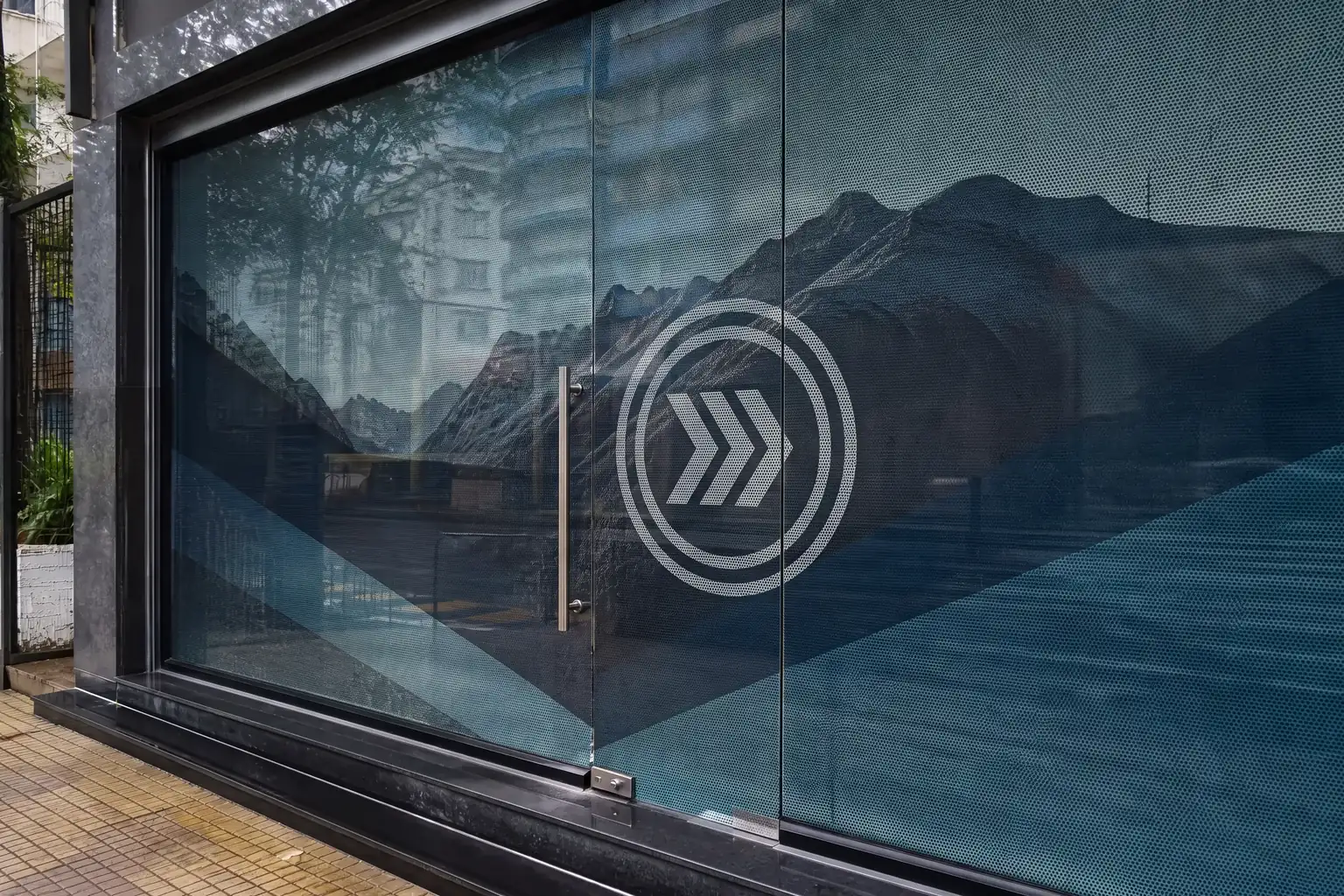
For perforated film, Clear Focus’s design guidance identifies limits on small text and detail for its patterns. Use the intended content in the sample review instead of judging only a blank film. Do not transfer a manufacturer’s suggested artwork settings to every product or assume that a logo remains equally legible on every construction.
Check the lighting that the office will actually use
Perforated-film view-through depends on the lighting relationship across the glass. Clear Focus recommends testing its film under the actual conditions and notes that a brighter interior at night can be visible from outside. An exterior daylight sample therefore cannot settle an evening screening brief.
Record the relevant day and evening conditions, occupied-room lights and viewing positions for each candidate. Include interior corridor glass where neither side follows a simple outside/inside lighting pattern. Ask the authorised user or designer to decide whether the observed result meets the brief. Leave the selection open if the required condition has not been reviewed.
Ask which product information applies to this panel
Identify the existing glass and coatings as far as the appointed building team can establish them. Record any existing film, damage or uncertainty. Send those details to the proposed supplier and ask for product-specific suitability guidance, application-side limits and the documentation the designer requires. An attractive sample does not establish compatibility.
Keep decorative selection separate from any safety, security, fire or other technical requirement assigned by the project. If such performance is required, the appointed specialist must identify and approve the appropriate system and evidence. This guide does not classify a decorative film as a safety or security system or prescribe a glass treatment.
Compare the complete supply and future-change scope
For each shortlisted option, request the panel dimensions, pattern or artwork, edge/joint treatment, product and print construction, installation and access scope in the offer. Identify removal of existing film and any making-good assessment separately. Include the cleaning guidance and the reference needed to order a replacement panel.
The client obtains the required landlord, building and statutory permissions and pays the fees. IBS drawing or liaison services are separately agreed and charged. Record the selection owner and the design issue they are accepting. A material choice should not be read as permission to work on every glazed panel.
Pass the selected construction into the approval record
Use this sheet to record which candidate was chosen, which were rejected and what remains unresolved. Keep the sample, lighting observations and approved artwork linked to that decision. If a product or the printed coverage changes, ask which parts of the selection review must be repeated before an order is released.
The existing wall-and-glass approval guide addresses the next step: actual surface condition, product trial, readiness, installation release and handover. Send IBS the selected or shortlisted construction, panel photographs and dimensions, quantity, location and target date. State the intended result plainly so the proposal can address your office rather than a generic film label.
Sources
- Dusted/frosted glass-effect construction and cut/printed design options. Product page read 25 November 2026; not used as evidence of universal privacy, suitability, stock availability or technical certification. 3M, Scotchcal Dusted/Frosted Crystal 7725SE-314
- A clear printable glass-film example. Product page read 25 November 2026; no durability, removability or unqualified view-through promise is adopted. 3M, Scotchcal Clear View Graphic Film 8150
- Relative lighting and brighter-interior night-time limitations of the manufacturer’s perforated films. Read 25 November 2026; actual conditions require review. Clear Focus Imaging, Lighting
- Small-detail/text limitations vary with the manufacturer’s perforation pattern. Read 25 November 2026; no universal font size or artwork rule is prescribed. Clear Focus Imaging, Design
Frequently asked questions
Should we choose frosted film or one-way vision for a meeting room?
Does perforated film provide one-way privacy after dark?
Is printed glass film always opaque?
Can a decorative film be treated as safety or security film?
Can one film be selected for all office glass?
How does this differ from the wall-and-glass approval worksheet?
What should we send IBS for office glass-film advice and pricing?

Selecting film for an office glass package?
Send panel photos, dimensions, quantity, location and target date, with the intended appearance or screening result and relevant lighting conditions.