 WhatsApp
Kiosk branding · Mumbai
Kiosk Branding & Mall Kiosks
in Mumbai
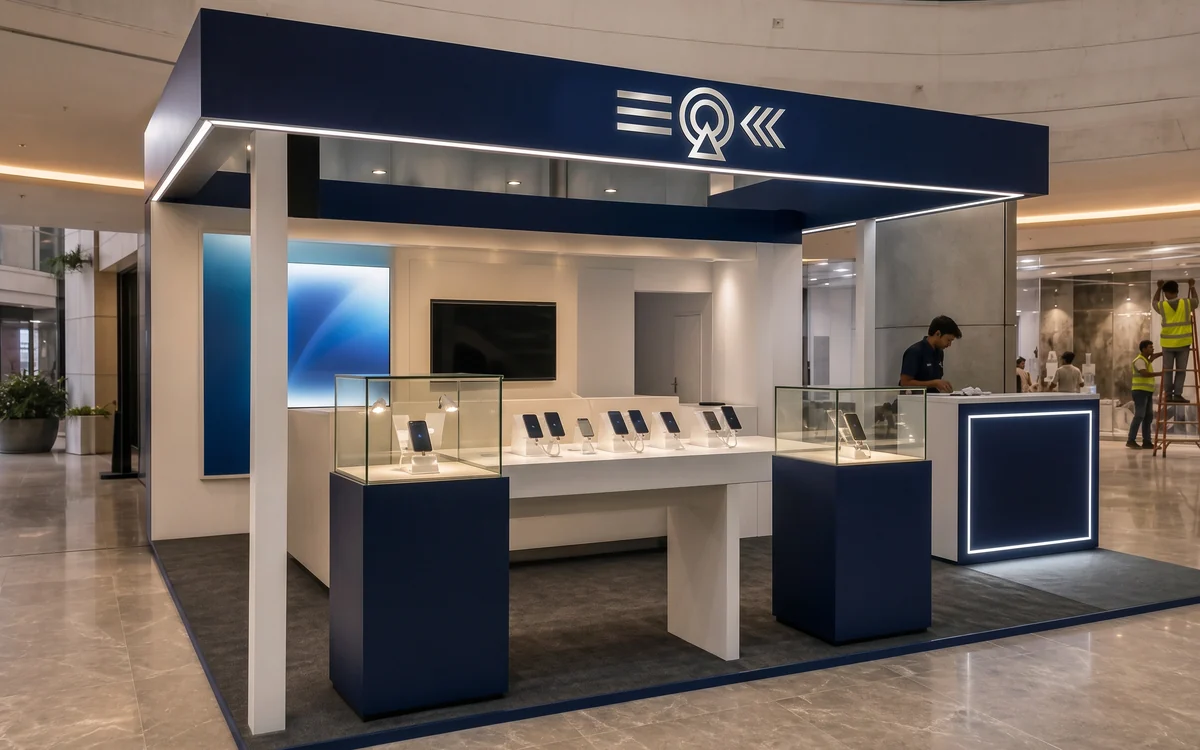
Mall kiosks, retail and promotional kiosks and knockdown units fabricated at IBS’s facility in Mumbai and its factory near Vasai East, then installed within the mall’s installation window. Mumbai’s building rules apply the National Building Code’s fire chapter and require Class 1 flame spread for interior finishes. IndiaMART listings put Mumbai retail kiosks at a median ₹4,000 per sq ft on 28 September 2026.
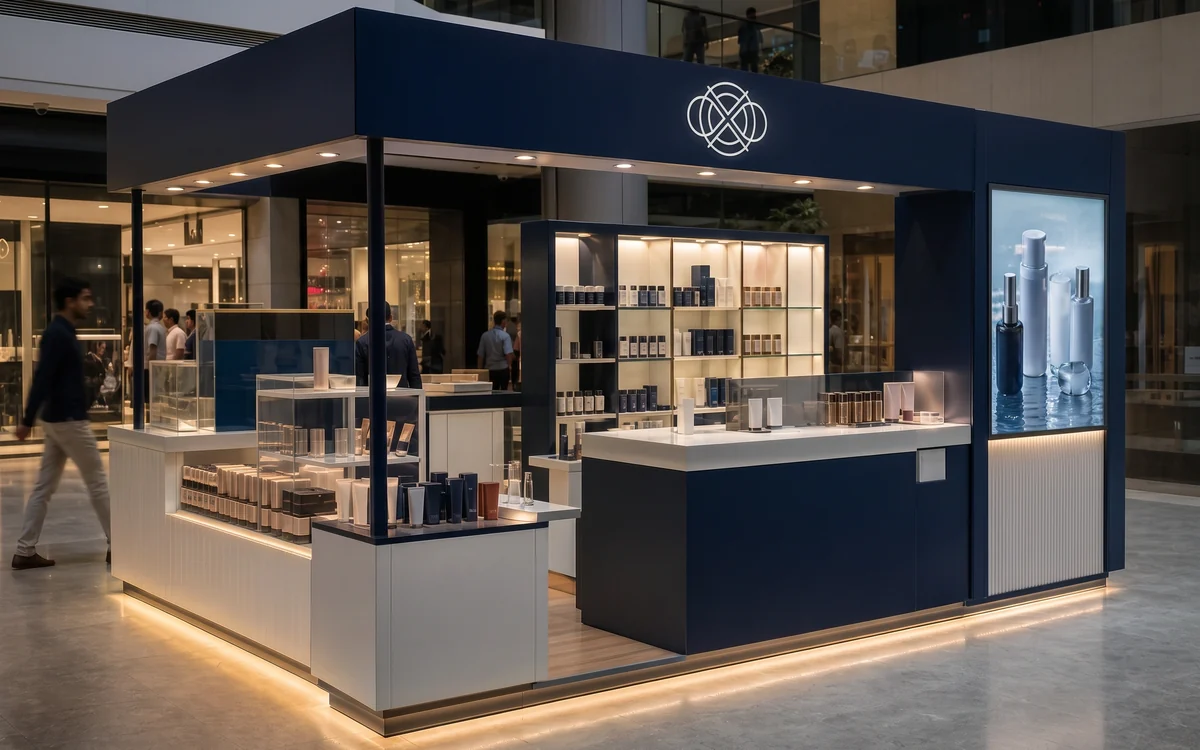
What does a mall kiosk in Mumbai involve?
A kiosk in a Mumbai mall has to pass the mall’s approval, keep exits and fire equipment clear, use interior finishes that meet Class 1 flame spread under DCPR 2034, and be wired by a licensed electrical contractor. A lit or screen kiosk may also fall under BMC’s advertising rules. Mumbai listings put retail kiosks at a median ₹4,000 per sq ft.
What is a mall kiosk?
A freestanding branded unit, usually a counter with display, storage and lighting, placed in a mall corridor, atrium or concourse rather than in a shop unit. It is built off site, brought in through the mall’s service routes and installed in a set window, so it has to be designed for transport as well as for trading.
What is Class 1 flame spread?
The lowest of four flame spread classes in the Indian standard IS 12777, which measures how far flame travels across a surface under radiant heat. Class 1 allows no more than 125 mm. Mumbai’s DCPR 2034 requires interior finishes to be no worse than Class 1.
What is a knockdown kiosk?
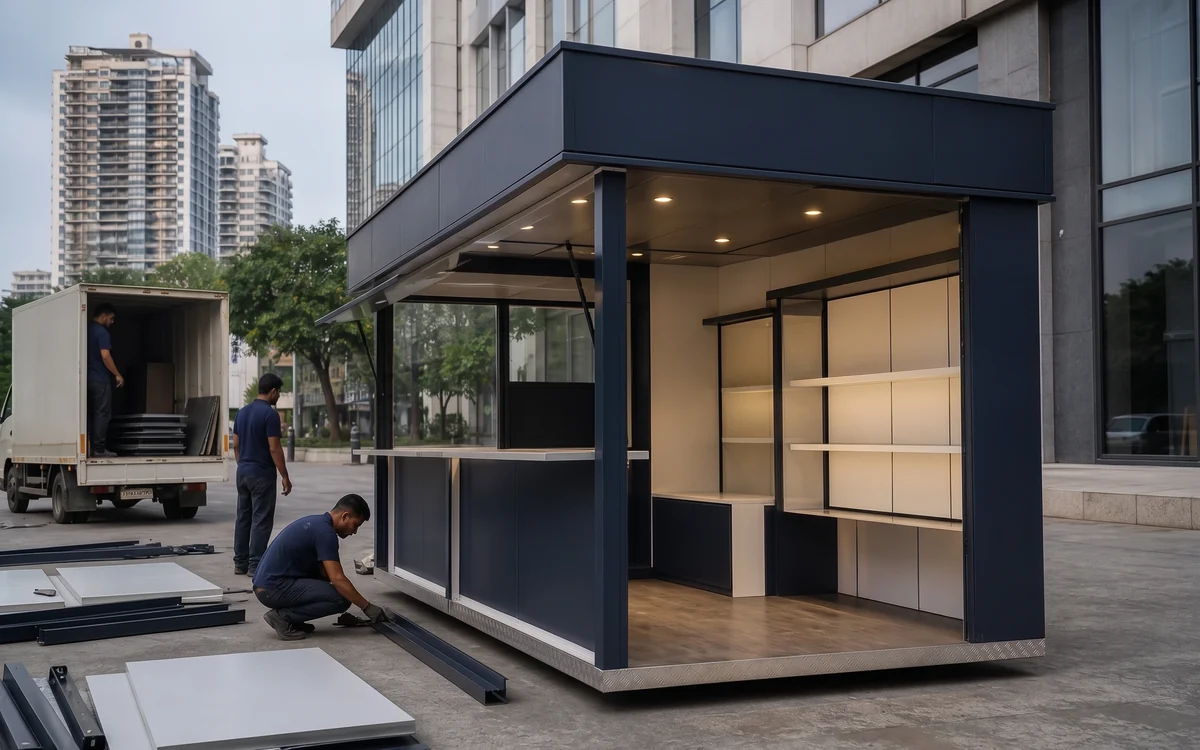
A kiosk built to be taken apart into panels and frames, moved and put back together without damage. It suits seasonal retail, launches and brands that move between malls, and it fits through service lifts and corridors that a fully assembled unit would not.
Fire rules
The fire rules a Mumbai mall kiosk has to meet
No Indian rule is written for kiosks by name. The rules that decide a kiosk’s materials and position are the state fire law, Mumbai’s building regulations and the National Building Code they point to.
Maharashtra Fire Act, 2006
- The mall owner or occupier holds the fire safety approval (section 3(1))
- Fire equipment kept in good repair and efficient condition at all times
- No one may tamper with, alter or damage fire equipment (section 3(4))
- An occupier includes a licensee in occupation of part of a building (section 2(10))
- Malls are commercial buildings under Schedule II
Mumbai DCPR 2034, regulation 47
- The National Building Code’s fire chapter applies (47(1))
- Interior finishes no worse than Class 1 flame spread (47(2)(b))
- Materials in stairways, corridors and facades non-combustible or fire resistant (47(2)(a))
National Building Code 2016, Part 4
- Exits and exit passageways kept free of all obstructions (clause 4.2.3)
- Combustible décor on an atrium floor limited and sparsely distributed (Annex F)
- Class 2 finishes not allowed on corridor walls; Class 4 not in corridors or staircases (clause 3.4.11)
- Maximum travel distance of 30 m in mercantile buildings
- No kiosk clause, so each mall sets its own kiosk rules on top
Approvals
Mall approvals, licences and BMC’s advertising rules
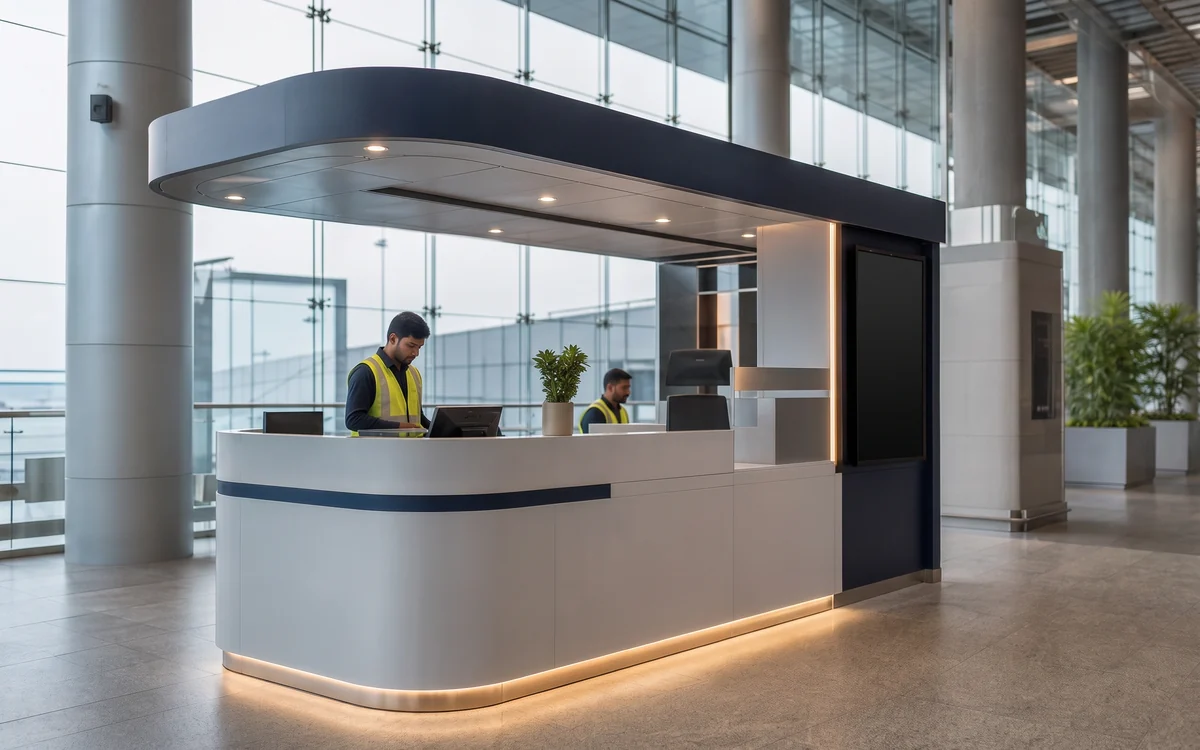
We found no Mumbai mall that publishes its kiosk or fit-out rules; they are issued to tenants and vendors directly. IBS works to the mall’s own document once you share it, and the brand holds the trading licences.
What to ask the mall for
- The mall’s kiosk or fit-out rules for your location
- The approved footprint and height for the spot
- The installation window and service route
- The drawings and material certificates the mall wants to approve
- The electrical point and the load it allows
Licences the brand holds
- Food: an FSSAI licence, or registration as a temporary stall holder (section 31)
- Serving food in Mumbai can need a BMC health licence under section 394 of the MMC Act
- That licence covers hygiene only; fire safety is cleared separately by the Chief Fire Officer
- A new establishment with fewer than ten workers gives an intimation under the Shops and Establishments Act
- No BMC licence rule was found for a non-food kiosk, so the mall and the brand confirm it
Lit and screen kiosks
- BMC’s 2025 policy needs written permission for glow, backlit and digital displays on business premises, naming malls
- It lists advertising within malls as a category (clause 2.2(c))
- Its definition of an advertisement covers displays visible from a street
- Ask whether the mall’s own BMC permission covers your display before booking the spot
Specification
How IBS builds a kiosk for a Mumbai mall
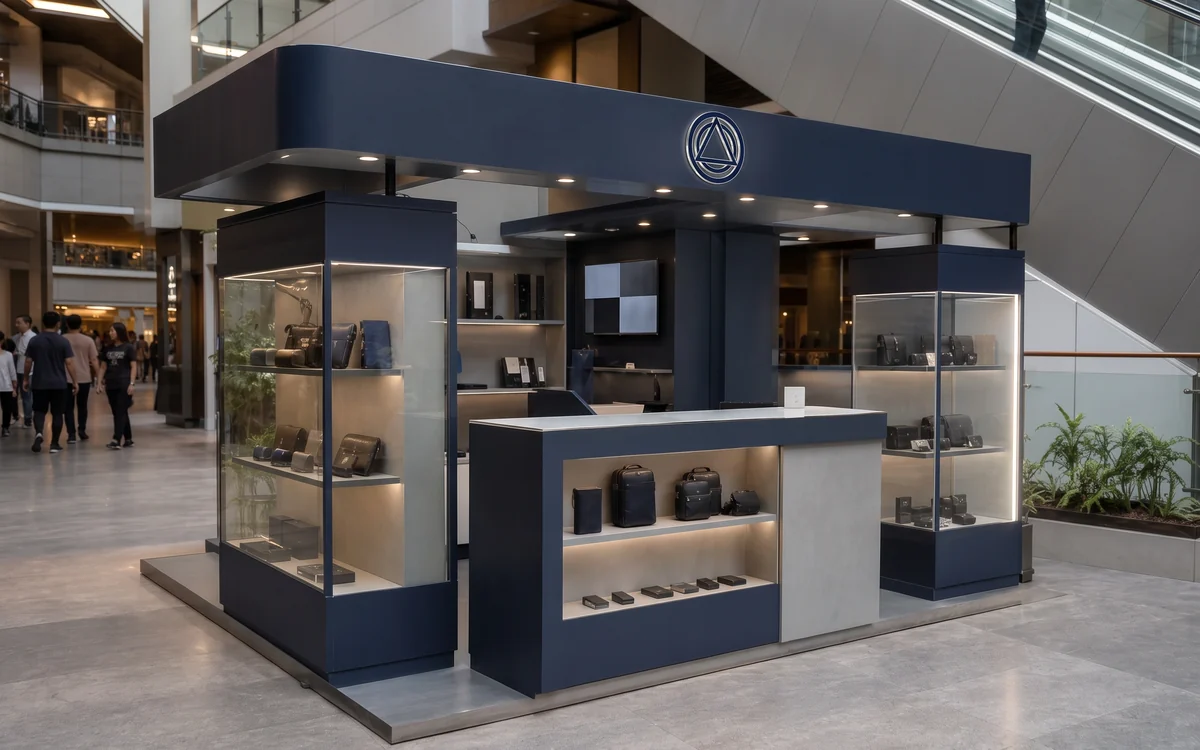
Kiosks are fabricated at IBS’s facility in Mumbai and its factory near Vasai East on the Mumbai–Ahmedabad Highway, then brought in and installed by the same team.
Structure and surfaces
- Fabricated MS and aluminium framing, with a plywood and MDF substructure
- Merino, Greenlam or Century laminates; PU and duco finishes for premium units
- Fire-retardant materials and finishes where the mall requires them; interior finishes to Class 1 flame spread, which DCPR 2034 requires
- ACP and acrylic for dimensional branding
Light, power and screens
- LED spot, strip and backlit modules with Mean Well or Schneider drivers
- Wired by a State-licensed electrical contractor (CEA Safety Regulations, regulation 31)
- Supply protected by a residual current device (regulation 44)
- Screen and touchscreen housings built around the client’s chosen hardware
Delivery and installation
- Dry-fitted or fully assembled at the factory to catch fit problems before site
- Knockdown construction where the mall’s service route needs it
- Branding printed in-house on 3M, Avery Dennison and ORACAL media
- Planned around sprinklers, detectors, hose reels and exit routes
What IBS’s Mumbai base changes for you
- Fabrication at the IBS facility in Mumbai, furniture and joinery at the factory near Vasai East; head office in Goregaon West
- Site survey, fabrication and installation by the same team, without a courier leg
- Service calls in the Mumbai-Pune corridor typically answered within 24 to 48 hours
- A line-item BOQ within five to seven working days of the brief
Commercials
How a Mumbai kiosk is priced and checked
A price per square foot hides more on a kiosk than on almost any other job, because listings rarely say whether it means footprint or finished surface. These are the lines that make two quotations comparable.
How the price is built
- A line-item BOQ against the drawing: structure, surfaces, branding, lighting and electricals
- Boards and finishes named with their fire rating
- Transport, installation and dismantling listed separately
- Licence and approval fees paid by the brand, shown separately
What to check in any quotation
- Is the fire rating of the boards and finishes stated?
- Is the electrical work by a licensed contractor included?
- Does the design fit the mall’s approved footprint and height?
- Can it be knocked down and moved to the next location?
Quality
How quality is checked before and after installation
Most signage faults in Mumbai trace back to something that could have been caught in the workshop.
Before it leaves the workshop
- Every lit board tested lit at the IBS facility before dispatch
- Colour proofed against one approved physical swatch
- Joints, gaskets and drainage checked on each box
- Earthing verified to IS 3043; electrical work to IS 732
At handover
- As-installed photographs, day and night for lit signs
- Electrical test records and warranty certificate in one file
- Signage workmanship warranted 12 to 24 months depending on the product
- A named IBS contact holding the drawings and spares
Approved vendor status
- IBS is an approved vendor at Adani Airports, HDFC ERGO, Reliance Retail, Godrej Finance, EPSON, Duravit and HSBC
- Company-level BCAS security clearance for airport projects; site access arranged per assignment
Planning a kiosk in a Mumbai mall?
Send the mall, the location and the mall’s kiosk rules if you have them. You get a drawing, a material list with fire ratings and a line-item BOQ.
Start a kiosk briefKiosk types for Mumbai malls
The reference price is IndiaMART’s retail kiosk listings on the Mumbai city page, 28 September 2026, not an IBS quotation; per-piece listings were too few and too mixed to use.
| What it is | Fire and approval points | Reference | |
|---|---|---|---|
| Retail or mall kiosk | A fixed branded counter unit for selling | Class 1 finishes; clear of exits and fire equipment | ₹2,500 to ₹5,000 per sq ft (median ₹4,000) |
| Food kiosk | A counter unit serving food or drink | FSSAI; BMC health licence where it applies; fire clearance from the CFO | Quoted per design |
| Promotional kiosk | A short-stay unit for launches and sampling | The mall’s approval and installation window | Quoted per design |
| Screen or touchscreen kiosk | A housing built around a display | Licensed wiring with RCD protection; BMC’s digital display rules may apply | Hardware priced separately |
| Knockdown kiosk | A unit that dismantles and moves | The same rules at each new location | Lower cost per reuse |
Market Context
What the published data says
- Retail kiosk listings in Mumbai: middle half ₹2,500 to ₹5,000 per sq ft, median ₹4,000, across 20 listings on 28 September 2026. IndiaMART, Retail Kiosks, Mumbai
- The owner or occupier holds the fire safety approval and keeps fire equipment in efficient condition at all times; no one may tamper with it. Maharashtra Fire Prevention and Life Safety Measures Act, 2006, sections 2 and 3 (text as on 7 July 2025)
- Mumbai applies the National Building Code’s fire chapter, and interior finishes may not exceed Class 1 flame spread. Development Control and Promotion Regulations for Greater Mumbai 2034, regulation 47 (sanctioned 8 May 2018)
- Class 1, the lowest flame spread class, allows no more than 125 mm of flame spread in the test. BIS, IS 12777:1989, Method for Classification of Flame Spread of Products
- Electrical installation work must be done by a State-licensed electrical contractor (regulation 31); luminous tube signs above 650 V need an outdoor emergency switch and 14 days’ notice to the Electrical Inspector (regulation 54). Central Electricity Authority (Measures relating to Safety and Electric Supply) Regulations, 2023, 8 June 2023
- An eating house licence under section 394 of the MMC Act covers health and hygiene only; fire safety is cleared separately by the Chief Fire Officer. MCGM Public Health Department, circular HO/44380/C, 1 March 2016
- No food business may operate without an FSSAI licence; a temporary stall holder registers instead. Food Safety and Standards Act, 2006, section 31
Questions Buyers Ask