 WhatsApp
How to Shortlist a Fit-Out Contractor in India: 12 Checks Before You Invite a Bid
People ask for the top ten fit-out companies in India. We have not found a neutral ranking of fit-out contractors in India that states a method you could check: the lists online are directories, paid listings or companies ranking themselves. A better shortlist comes from evidence. Twelve checks cover it: who does the work, what they have built at your size, which registrations and clearances they hold, and how they handle drawings, safety, handover and defects. Run them before inviting a bid, and the tender compares contractors who can all do the job.
Why there is no reliable “top 10” list
Search for the best fit-out companies in India and you get directories, some of which rank by paid placement, articles written by one of the companies listed, and lists of the largest construction groups, many of which build infrastructure rather than office floors. None of them tells you whether a contractor can build your drawings, at your size, by your date.
Public tenders do not rank contractors by reputation either. They set eligibility criteria and ask for documents that prove each one. A private shortlist can borrow the same discipline without the paperwork of a public tender.
Start from the project, not from a list
Shortlisting criteria only make sense against a defined project. Fit-out budgets are large enough to justify the effort: Cushman & Wakefield puts the cost of a collaborative hybrid office fit-out at about ₹6,567 per sq ft in Mumbai, ₹6,207 in Delhi and ₹6,027 in Bengaluru (Cushman & Wakefield, 2026). At the Mumbai figure, a 20,000 sq ft floor is roughly ₹13 crore of work.
Before looking at contractors, write down the handful of facts that decide who can bid.
- Design status: GFC drawings and a BOQ from your architect, or a brief the contractor must design from
- Trades in scope: civil, MEP, fire fighting, HVAC, joinery, furniture, finishes, signage
- Size and value, in sq ft and an order-of-magnitude budget
- Site constraints: an occupied building, a mall with landlord rules, a hospital that stays open, an airport
- The date the space must be usable, and any fixed milestones before it
Checks 1 to 3: who actually does the work
On our sites, the delays we see most start at the handover between trades. A contractor that sub-contracts MEP, fire fighting and joinery is managing those handovers for you, and its own staff may never touch the work. Public tenders take this seriously: the Mumbai Port Authority’s 2026 office renovation tender requires the prime contractor to name its electrical, HVAC and fire fighting subcontractors, with completion certificates from their clients.
- Check 1, in-house trades: ask which trades are executed by the contractor’s own engineers and workmen, and which are sub-contracted, trade by trade
- Check 2, the subcontractor list: for any sub-contracted trade, ask for the subcontractor’s name and a completed project you can verify
- Check 3, fabrication: ask where joinery, furniture and metalwork are made, and whether you can visit the factory. Mumbai International Airport’s September 2026 expression of interest for interior and MEPF works asks bidders for an in-house factory set-up
Identifying and establishing shortlisting criteria for the Contractor, General Contractor, Sub Contractors and Vendors.
Council of Architecture, Manual of Architectural Practice, on the architect’s tender-stage servicesChecks 4 to 6: similar work at a similar size
Public tenders define similar work precisely. The Mumbai Port Authority tender asks for one completed similar work of 80% of the estimated cost, or two of 50%, or three of 40%, within the last seven years, with older values brought to current cost at 7% a year. Similar work is defined as renovation and interior works to government, private or corporate offices, banks, hospitals and similar premises.
The same logic works on a private project. A contractor that has built a 5,000 sq ft branch has not proved it can run a 60,000 sq ft headquarters, and a contractor that has only built offices has not proved it can work inside a running hospital.
- Check 4, comparable projects: ask for two or three completed projects of a similar type and at least half your value, with the client named
- Check 5, the largest single order: ask for the largest single order the contractor has executed, and compare it with your project
- Check 6, a site you can visit: ask to see a live or recently completed site, and speak to the client’s facility or project team
Checks 7 and 8: registrations, compliance and site clearances
Registrations are pass or fail, and they are easy to verify. Ask for the documents rather than a statement. The Mumbai Port Authority tender asks for GST registration, EPF and ESIC registration, and a labour licence where the deployed manpower exceeds 19. PMCs such as JLL ask invited vendors for certificates of insurance and a risk assessment during onboarding.
- Check 7, statutory registrations and insurance: GST, EPF and ESIC, labour licences where applicable, and insurance certificates for the works and for workmen
- Check 8, site-specific clearances: for airside airport work, BCAS clearance, which MIAL’s 2026 expression of interest counts as a plus rather than a requirement; for landlord-controlled buildings, whether the contractor has worked under that landlord’s fit-out rules before
Check 9: the quality of the BOQ response
Before a full tender, ask each contractor to price a short extract of your BOQ or a single typical room. The response shows more than the rates. It shows whether the contractor reads the drawings, lists its assumptions and exclusions, and prices what you asked for rather than what it would prefer to build.
- Every line priced, with no lump sums hiding MEP or provisional sums standing in for real items
- Assumptions and exclusions written down, including site protection, working hours and vertical transport
- Alternates offered as priced options, not substituted into the base price
- A programme worked back from your date, showing the long-lead items
Check 10: how they handle drawings, samples and queries
The Council of Architecture’s Manual of Architectural Practice gives the architect the job of reviewing the contractor’s shop drawings, product data, samples and requests for information during construction. A contractor that handles these well protects the design. One that handles them badly turns every detail into a site decision.
- Ask for a sample shop drawing from a past project, and how long its submittals typically take
- Ask how written queries are logged and closed, and who answers them on site
- Ask whether it builds mock-ups or sample areas for approval, and at what point in the programme
Check 11: quality, safety and reporting
Some large clients ask for this at prequalification. The MIAL expression of interest asks for quality and HSE policies, and for a QMS plan and an HSE plan in the technical submission. On a private project the same documents tell you how the site will actually be run.
- A project quality plan: inspection stages, hold points and who signs them off
- An HSE plan: site induction, permits to work, and how hot work and work at height are controlled
- Progress reporting against the programme, and how often the PMC or client receives it
Check 12: handover and defect closure
The defect liability period after handover is where a contractor’s promises are tested: one year for civil and MEP works in the Mumbai Port Authority tender, with a longer period for its waterproofing, and 24 months in the MIAL expression of interest. The Mumbai Port Authority also holds 5% of the contract price as retention, released against the defect liability period.
- Warranty terms stated in months for each trade, with manufacturer warranties passed through
- As-built drawings, test records and O&M manuals listed as handover deliverables
- A named person and a response time for defects reported after handover
Turning the twelve checks into a shortlist
Treat the checks in two groups. The first are gates: a contractor that fails one does not go further, however good its rates. The second are scored, and they separate capable contractors from each other.
On an architect-led project, the architect helps write these criteria. The Council of Architecture manual lists identifying and establishing shortlisting criteria for the contractor among the architect’s tender-stage services, alongside techno-commercial analysis of the bids.
- Gates: registrations and insurance, site-specific clearances, similar work at a comparable size
- Scored: in-house trades, BOQ response, submittal handling, quality and HSE plans, handover and defect terms
- References: a conversation with a past client carries more weight than any document
How IBS answers these checks
IBS is a Mumbai-based execution contractor with more than fifteen years of operating history. It builds the architect’s design rather than competing for it. Civil works, MEP, fire fighting, HVAC, interiors, painting, epoxy flooring and furniture are executed by its own engineers and workmen, and furniture and joinery are made at its factory near Vasai East.
Its largest single order executed to date was worth ₹25 crore. It holds all registrations required under Indian law, is BCAS-cleared to work across the entire airport premises including airside, and is an approved vendor at Adani Airports, HDFC ERGO, Reliance Retail, Godrej Finance, EPSON, Duravit, HSBC, Tata CLiQ, Canon, Aditya Birla Fashion and Retail and HDFC Life. Named projects include GroupM’s Mumbai office and interior and branding work in airport terminals for Adani Airports.
On a live project, IBS raises written queries against the drawings and tracks each to an answer, offers value engineering only as priced alternates, builds mock-ups where the contract asks for them, and reports to the PMC against the programme with QA and HSE plans. It welcomes a pre-bid site visit where the project allows one.
Sources
- Collaborative hybrid office fit-out costs of about INR 6,567 per sq ft in Mumbai, 6,207 in Delhi and 6,027 in Bengaluru. Cushman & Wakefield, India Office Fit Out Costs and Market Insights 2026
- The architect’s tender-stage services, including identifying and establishing contractor shortlisting criteria, and review of shop drawings, product data, samples and RFIs. Council of Architecture, Manual of Architectural Practice, Vol. 4
- Similar-work eligibility of 80%, 50% or 40% of estimated cost, named subcontractors for electrical, HVAC and fire fighting, GST, EPF, ESIC and labour-licence requirements, 5% retention, and defect liability of one year for civil and MEP with a longer period for waterproofing. Mumbai Port Authority, Tender CE.T.59/2026, technical bid
- A September 2026 expression of interest for interior, facade and MEPF works at CSMIA Terminal 1 with a 24-month defect liability period, an in-house factory set-up, quality and HSE policies, and QMS and HSE plans in the technical submission. Mumbai International Airport Ltd, EOI for Interior, Facade and MEPF Work (ATCGR project, T1), issued 7 September 2026
- Vendor due diligence for invited suppliers, including a non-disclosure agreement, certificates of insurance and a risk assessment profile. JLL India, Vendors
Frequently asked questions
What are the top 10 interior fit-out companies in India?
What is a fit-out contractor?
What are fit-out companies?
How do I choose a fit-out contractor?
What documents should I ask for when prequalifying a contractor?
How much does an office fit-out cost in India?
What is a defect liability period?
Should the fit-out contractor also do the design?
What is the difference between a fit-out contractor and a PMC?
Why does it matter whether trades are in-house?
Who writes the shortlisting criteria for a contractor?

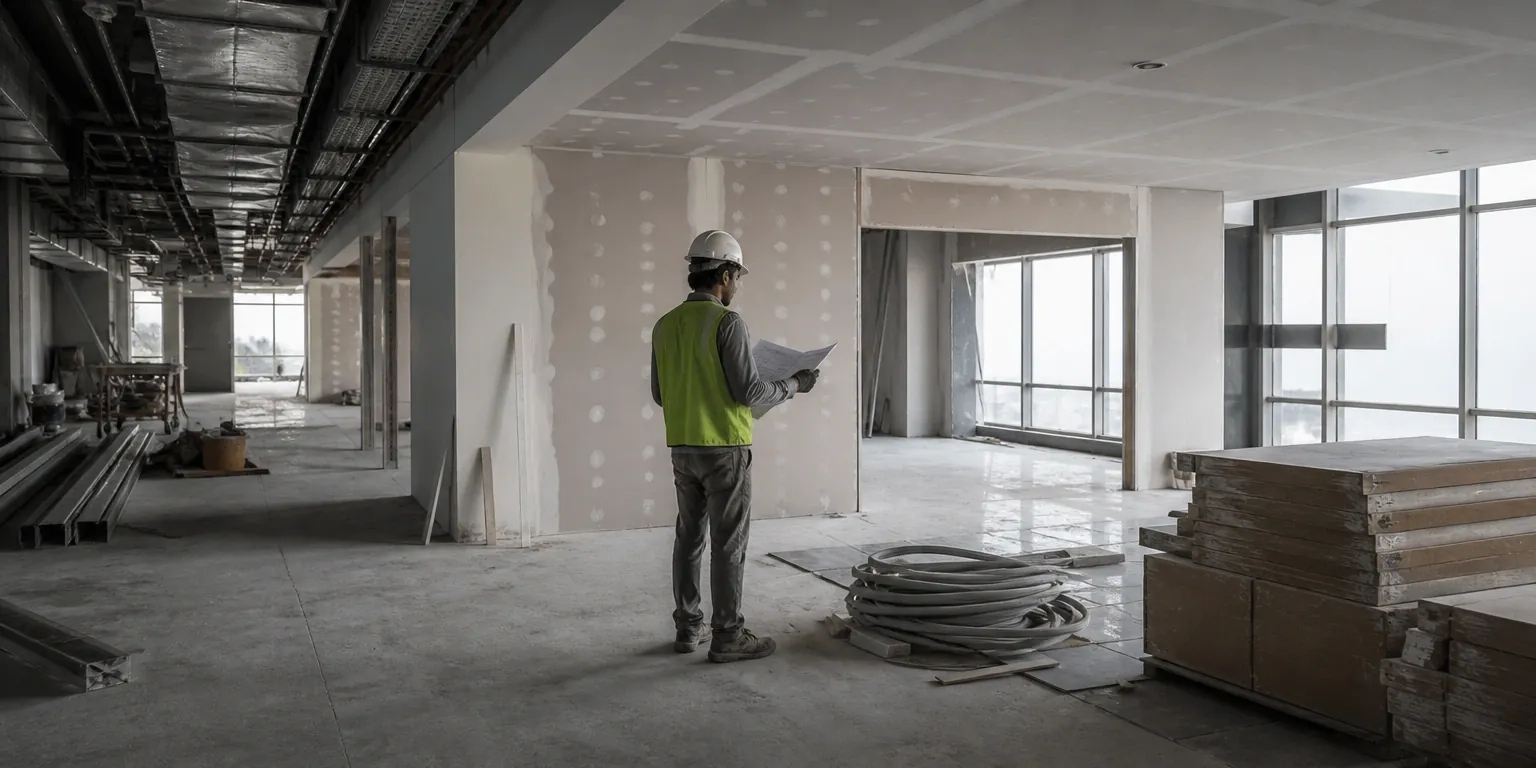

In-house execution.
Single-point accountability.
From signage and in-branch graphics to full interior fit-outs. IBS manufactures and executes in-house, pan-India.